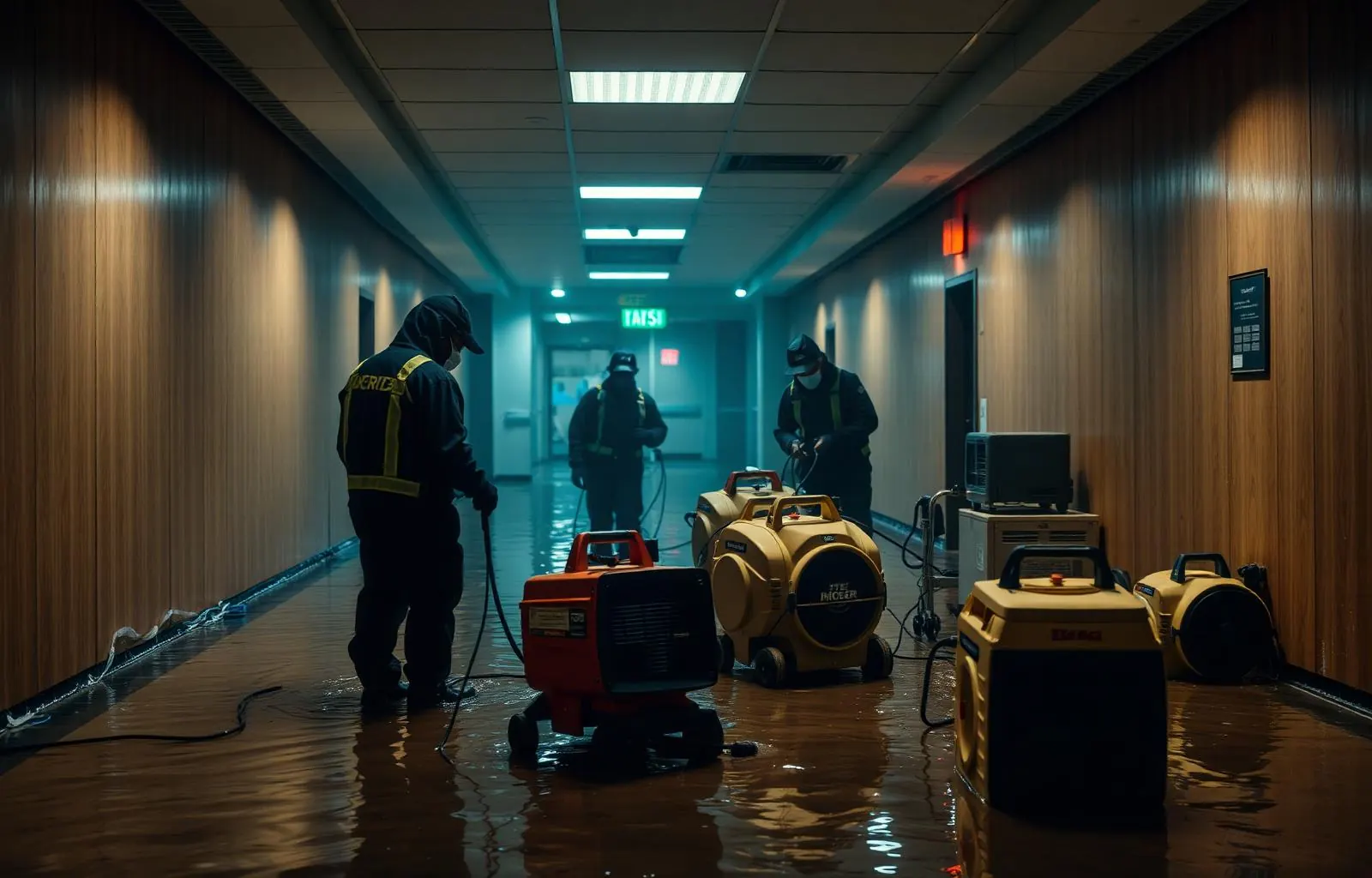
The single biggest determinant of how much a commercial water loss costs is what happens in the first 24 hours. Same source, same square footage — a fast-response site might land at $40,000 total restoration. A slow-response site can balloon to $400,000 or more, almost entirely because of secondary mold remediation and demolition that wouldn't have been needed if drying had started earlier.
Here's the playbook every asset manager and chief engineer should have ready before a loss hits.
The first 24 hours, summarized
Hour 0–1: stabilize and document
- Shut off water at the nearest upstream isolation. Building main if needed, but a closer riser or zone valve usually works.
- Kill power to affected areas at the panel — not at switches. Standing water and energized circuits are how people die at water losses.
- Photograph everything before moving anything. Wide shots of every affected room, then close-ups of damaged finishes and contents. Insurance adjusters work from these.
- Notify the property manager, asset manager, and tenants. Pre-printed water-loss notice templates save hours of confusion.
- Call your restoration vendor. A 60-minute response gets a stabilization crew on site by hour 2; a 4-hour response often loses an entire day.
Hour 1–6: extract and start drying
This is the highest-leverage window. The right activities:
- Extract standing water with truck-mount or portable extractors — not shop vacs. A truck-mount can pull 200+ gallons per hour from carpet.
- Remove wet contents to a dry staging area. Document content condition and location before moving.
- Lift saturated carpet and dispose of carpet pad (almost never restorable).
- Set air movers and dehumidifiers in proper IICRC S500 drying-chamber configuration. One air mover per 12–16 linear feet of wall, dehumidifier sized to grain-removal requirement of the chamber.
- File first notice of loss with the carrier. Don't wait for the adjuster to arrive — file the claim, document mitigation as you go.
Hour 6–24: contamination assessment and demolition decisions
Determine water category
Per IICRC S500:
- Category 1 (clean): broken supply line, sink overflow without contaminants. Most materials restorable with aggressive drying.
- Category 2 (gray): dishwasher discharge, washing-machine overflow, toilet overflow without solids. Carpet pad and porous materials in direct contact require removal.
- Category 3 (black): sewer backup, flood water, prolonged Category 2. Aggressive demolition: drywall typically cut to first bridging above water line, all carpet and pad disposed, antimicrobial application required, full PPE for crews.
The category drives every subsequent decision. Calling a Category 3 \"Category 2\" to save money is the single most expensive mistake we see asset managers approve under pressure — mold and indoor-air liability follow inevitably.
Identify non-restorable materials
Even Category 1 events typically require disposal of: carpet pad, MDF / particleboard, porous insulation, lower drywall (often 12–24\" cut), wet ceiling tile. Restorable: hardwood (often), engineered floors (sometimes), gypsum wall finish above the water line, structural framing if dried within 48 hours.
Begin documentation packet
IICRC S500 requires daily moisture-content readings, drying-chamber psychrometrics, and equipment placement logs. This is what gets paid by the carrier. A complete documentation packet typically returns 15–25% more on the claim than a partial one.
Day 2–4: structural drying
Daily moisture monitoring against pre-set drying goals (typically equilibrium moisture content + 4%). Equipment adjusted, repositioned, or removed as zones dry. Most Category 1 commercial losses dry in 3–5 days; Category 3 may run 7–10 days plus full antimicrobial protocol.
Day 5–10: reconstruction begins
Drywall replacement, flooring restoration, paint, and trim. The advantage of running mitigation and reconstruction under one CSLB B-licensed contractor (rather than handing off after dry-out) is continuity of documentation and a single point of accountability for the carrier.
What to keep in the building's emergency packet
- Building water shut-off location and key
- Electrical panel locations and breaker map
- Restoration vendor contact + after-hours dispatch number
- Insurance carrier first-notice-of-loss number
- Pre-printed tenant water-loss notification template
- Photo template (which rooms / angles to capture)
Bottom line
The cost of a commercial water loss is largely set by hour 24. Speed of response, correct extraction, properly-designed drying chambers, and accurate IICRC S500 contamination categorization make the difference between a five-figure event and a six-figure event. Build the playbook before you need it — and lock in a 24/7 IICRC-certified restoration partner now, not at 2 a.m. on a Saturday.