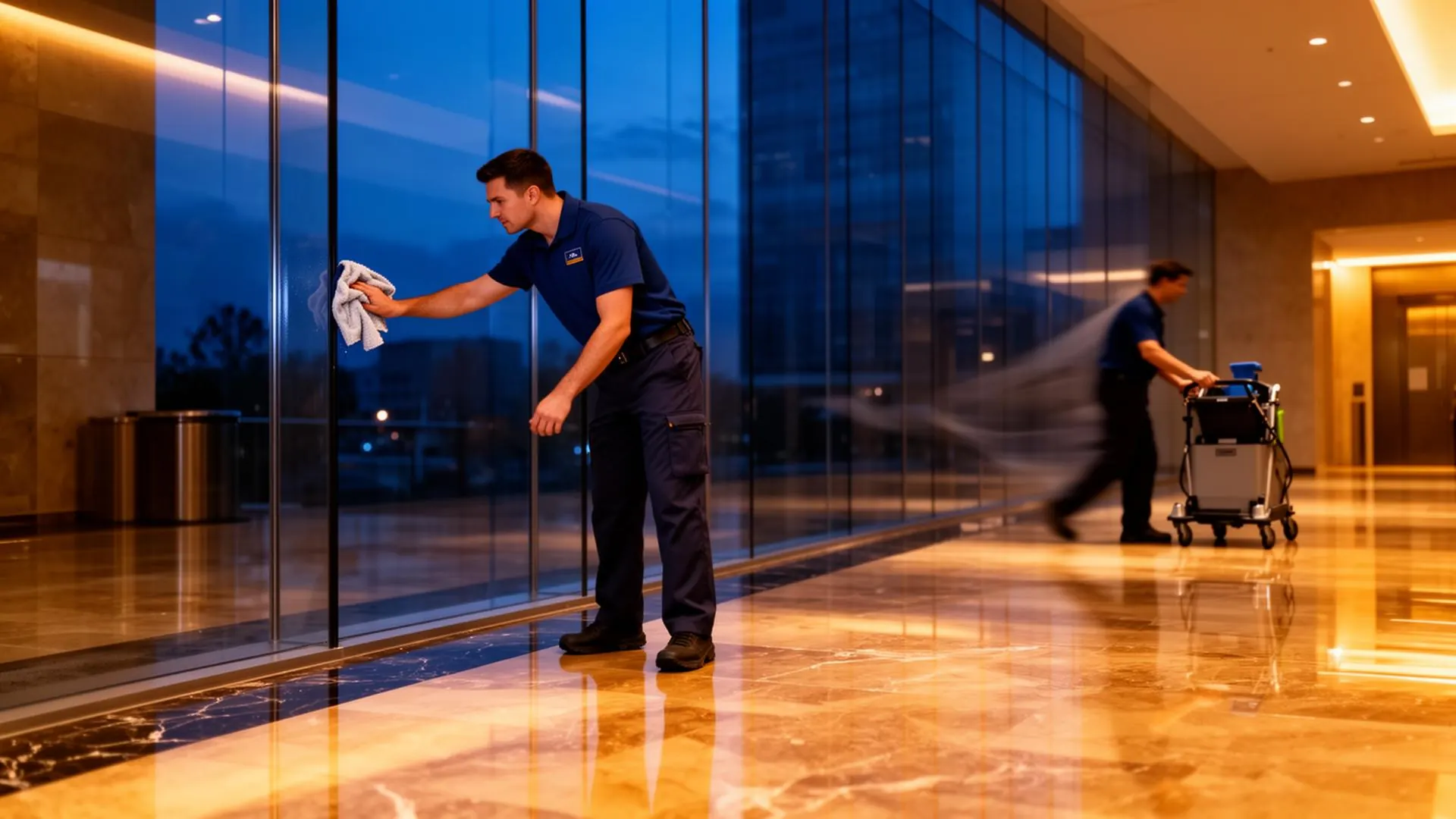
Cleaning frequency is the question every property manager asks the wrong way. The right question isn't \"how many nights a week\" — it's \"what does my tenant mix demand for perception, what does my industry demand for compliance, and what does my building demand for asset preservation?\" Here's the frequency benchmark we use across SoCal commercial properties, broken down by property type.
The short answer
Class-A office: 5 nights + day porter is the baseline
Above ~30,000 rentable square feet in a multi-tenant Class-A property, anything less than 5-night night crew plus 8-hour day porter starts showing up in tenant satisfaction surveys within 90 days. The night crew handles the volume — vacuum, restroom restock, trash, kitchen breakdown, dust. The day porter handles perception — restroom touch-ups every hour, lobby glass, elevator landings, spill response, and the dozen small things tenants notice between 8 a.m. and 6 p.m.
Property managers who try to save 15% by cutting day porter hours almost always pay for it in tenant complaints within two quarters.
Class-A floor-care cadence
- Carpet vacuum: nightly in common areas, 3×/week in suites
- Carpet hot-water extraction: quarterly in lobbies, semi-annually in suites
- Hard-surface burnish: weekly in main lobbies
- Strip-and-wax (or refinish): annually for VCT, every 18–24 months for terrazzo polish
- Window cleaning (interior): quarterly; exterior: semi-annually
Medical and clinical: 7-day floor with infection control
Medical office is a different category entirely. Infection control isn't a feature — it's the program. EPA List N disinfectants, color-coded microfiber by zone (exam room vs. waiting room vs. restroom), bloodborne-pathogen-trained staff, and OSHA recordkeeping are baseline. Frequency is dictated by the clinical day, not by a tenant's after-hours preference. For ambulatory surgery centers, terminal cleans between cases are non-negotiable.
Retail and hospitality: high-touch, high-frequency
Retail and hospitality both run on perception. Day-porter density is everything. For a 200-room hotel public-space program, you'd typically run 3 day porters during peak (lobby, conference, F&B) plus a 5-person night crew. For a regional shopping center, hourly restroom inspection during operating hours is table stakes.
Industrial and warehouse: less frequent, more specialized
Industrial property doesn't need office-grade cleaning frequency, but it does need specialized programs:
- Office areas: weekly cleaning is the workable floor
- Production / warehouse floors: monthly scrub-and-recoat
- Dock and bay door areas: quarterly degreasing
- Restrooms (employee): daily during shift hours
- High-bay light dusting: annually (combine with relamping)
HOA common areas: under-cleaned almost universally
HOA boards routinely under-spec common-area cleaning. Lobbies, fitness rooms, pool decks, and elevator landings in a 200-unit condo see 1,000+ touchpoints per day. 5-night cleaning plus weekend coverage is the right benchmark for any urban HOA above 100 units.
How to evaluate your current program
Three diagnostics:
- What's the day-porter-to-night-crew labor split? If day porter is under 25% of total janitorial labor in Class-A or hospitality, you're under-resourced where tenants see it.
- Is monthly QA done by a non-account supervisor? Self-inspection from the same crew that did the work isn't QA — it's a checkbox.
- How many tenant complaints per quarter? Above 8–10 in a Class-A property is a frequency or supervision problem, not a worker problem.
Bottom line
Don't chase the lowest cadence — chase the cadence that holds tenant satisfaction. For most SoCal Class-A: 5-night plus full-day porter. For medical: 7-day with clinical-grade chemistry. For industrial: weekly office plus specialized floor and dock programs. And for every property: insist on photo-documented monthly QA from someone who isn't on the cleaning crew.