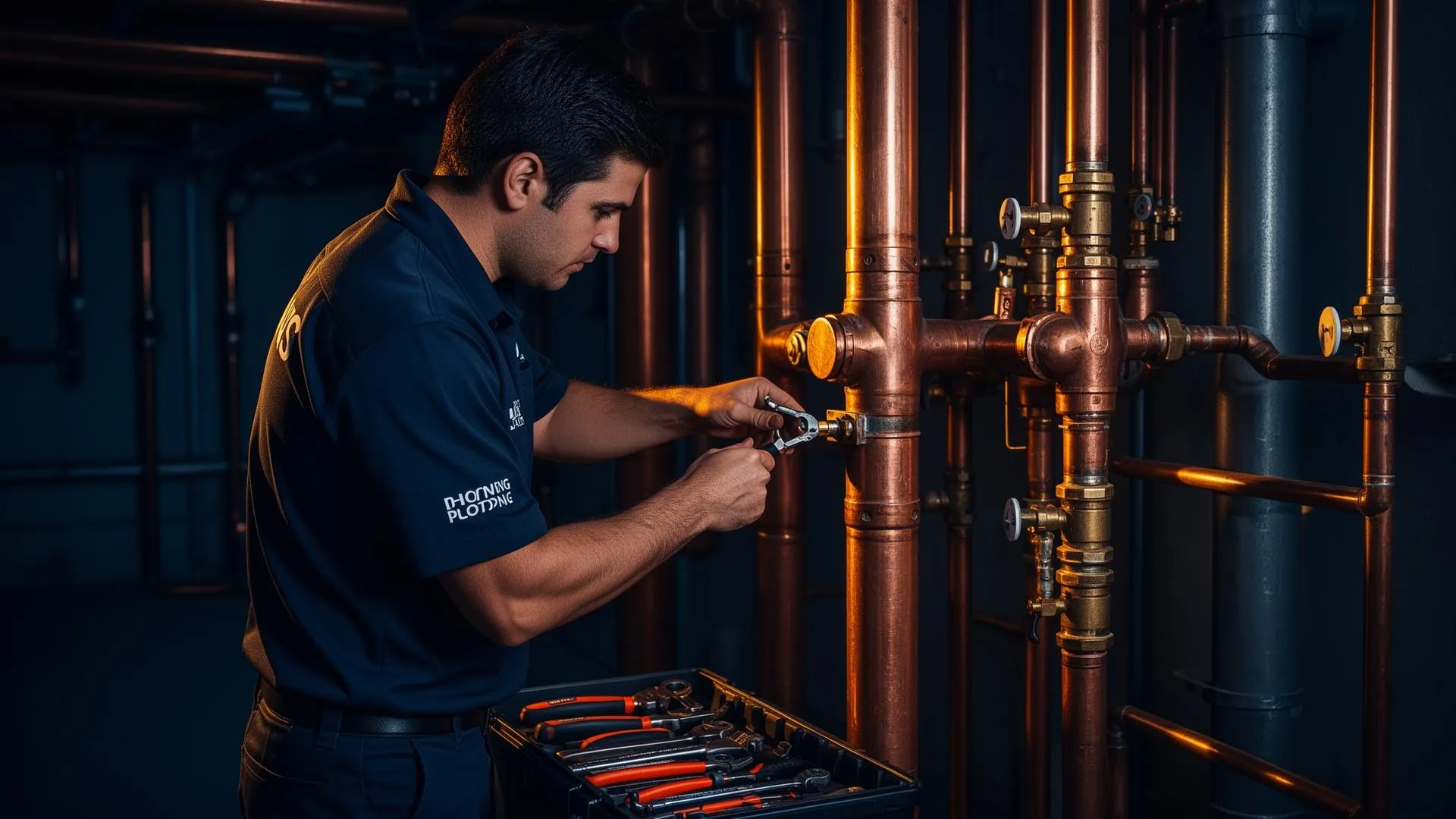
\"Commercial plumbing PM\" gets sold as a line item on a janitorial bid by half the vendors in SoCal. It's not. A real annual plumbing PM program for commercial property covers backflow compliance, hard-water mitigation, slab-leak monitoring, sewer-line video, fixture descaling, and water-heater maintenance. Skip any of them and you're rolling the dice on a five-figure surprise.
The annual checklist
1. Backflow preventers — annual certified testing
California Title 17 and every SoCal water purveyor require annual testing of all backflow prevention assemblies by an AWWA-certified tester, with results filed to the water district. Reduced-pressure (RP), double-check (DC), and PVB assemblies all qualify. Missed tests trigger compliance letters and, eventually, service shutoff.
Most multi-tenant commercial buildings have between 3 and 12 backflow devices (irrigation, fire-line, domestic, mechanical). Test fees are modest; the real risk is missing the test and finding out via compliance letter.
2. Hard-water descaling — quarterly
Southern California water hardness ranges from moderately hard (LA basin) to extremely hard (Riverside, San Bernardino, parts of San Diego County). Hard water destroys flushometers, faucet aerators, tankless coils, ice machines, and dishwasher elements faster than any other failure mode in commercial plumbing.
Quarterly chemical descaling (vinegar or commercial CLR-type product) on every restroom flushometer and faucet aerator extends fixture life by 3–5 years. For severe-hardness sites we install scale-inhibitor systems (template-assisted crystallization or nano-filtration) on the building feed.
3. Slab-leak monitoring — every 24 months
For any commercial slab building over 15 years old, slab-leak monitoring should be a standing PM line item. Acoustic listening or thermal-imaging scans every 24 months catch pinhole copper leaks before they fail catastrophically. A caught slab leak runs $1,500–$4,000 to repair. A failed slab leak with concrete cutting, restoration, and tenant disruption runs $25,000–$80,000.
4. Sewer-line video inspection — every 24–36 months
Push-camera or self-leveling crawler video on building sewer mains catches root intrusion, belly settlement, and pipe deterioration before it manifests as a backup. Restaurants and any food-service tenant need 12–18 month frequency because of grease accumulation. The cost of inspection is modest; the cost of a Friday-night sewer backup in a Class-A lobby is not.
5. Water-heater PM — annual
Annual sediment flush, anode-rod inspection (replace at <50% remaining), TPR valve test, expansion-tank pressure check. For tankless heaters, annual descaling is non-negotiable in hard-water zones — skipping it shortens system life by half. Commercial water heaters are the single most predictable plumbing failure when PM is skipped.
6. Fixture rebuild — as-needed but inspected quarterly
Flushometer diaphragms, faucet cartridges, and toilet fill-valve assemblies all wear on schedule. Quarterly inspection catches them before they leak. Restaurant pre-rinse units and commercial kitchen faucets typically need annual rebuild.
7. Grease-trap maintenance — by use frequency
Health-department-mandated for any food-service tenant. Cleaning frequency depends on grease load (some QSR sites need monthly; coffee tenants might run quarterly). Manifests must be filed with the appropriate sanitation district.
What a real PM report looks like
Every visit should produce: backflow test certificates (annual), photo documentation of fixture condition, water-heater anode and sediment notes, scale-inhibitor logs, and a forward-looking 12-month replacement forecast. If your current vendor delivers a one-line invoice, you don't have PM — you have on-call repair waiting to happen.
Bottom line
A real commercial plumbing PM program runs $0.04–$0.12 per square foot annually depending on fixture density. That covers backflow compliance, hard-water mitigation, slab-leak scanning, sewer video, water heater PM, and quarterly fixture inspection. The math against a single avoided slab-leak event is overwhelming.